
Operation Marquês: The Farce That Puts an Entire Country on Trial
Fragmentos do Caos · FC-Chronic-News
Operation Marquês: The Farce That Puts an Entire Country on Trial
José Sócrates is the most visible name. But the real trial is that of a regime that lived comfortably with the promiscuous relationship between power, money, banking, slow justice, and the chronic absence of consequences.
By Aletheia Veritas · For Fragmentos do Caos
There are judicial proceedings that put defendants on trial. And there are proceedings that, because of their duration, symbolic weight, political ramifications, and procedural decay, end up putting an entire country on trial.
Operation Marquês has long since moved beyond the figure of José Sócrates. Legally, there are concrete defendants, concrete charges, concrete defences, and courts that must decide based on evidence, not public foam. This must be repeated, because justice should not be replaced by popular bonfires, no matter how much the national spectacle sometimes makes one look for matches.
But politically, Operation Marquês is something else.
It is the mirror of an entire system. A system of ruling parties, successive governments, administrative machines, economic elites, distracted regulators, banks treated like cathedrals, large groups protected by institutional reverence, slow justice, media fed by leaks, and citizens reduced to universal payers of the feast.

This is not merely the case of a former prime minister sitting in the dock. It is the portrait of a democracy that, for decades, confused governance with a network of favours, the State with a distribution agency, banking with an altar, public works with national salvation, and responsibility with a pretty word for late-afternoon speeches.
Portugal looks at Operation Marquês and sees more than a trial. It sees an era. It sees a culture of power. It sees a way of operating. It sees the old dance between politics, money, influence, business, banking, public works, consulting, foundations, advisers, intermediaries, and that discreet fauna that never appears on election posters but always appears close to the safe.
1. The Former Prime Minister and the Country That Pretends to Be Surprised
José Sócrates did not fall from the sky like a political meteorite. He was a product of a system. He grew within it, shone within it, commanded within it, and became one of its most emblematic figures.
The problem is that this same system now pretends it was distracted.
The parties of power always do this with almost artistic skill: when everything goes well, they appear in the photograph; when everything goes wrong, they claim the frame belonged to another department.
But Sócrates did not govern in a vacuum. He governed in a country with parties, banks, businessmen, regulators, major law firms, mayors, ministers, secretaries of state, public administrations, parliamentary oversight, courts, magistrates, journalists, commentators, and institutions that, in theory, existed to prevent power from turning into private property with a national flag.
And yet, for years, the country witnessed a succession of scandals, suspicions, financial collapses, opaque deals, ruinous public decisions, failed banks, protected companies, crossed interests, and public works presented as historical destiny.
Then, when the bill arrived, everyone discovered a very convenient institutional innocence.
- Nobody saw anything.
- Nobody heard anything.
- Nobody suspected anything.
- Nobody knew anything.
- Nobody could have imagined.
- Nobody had competence.
- Nobody had power.
- Nobody had responsibility.
A country governed by ghosts, apparently. But ghosts with salaries, drivers, cards, offices, and pension rights.
2. Slow Justice as a Form of Moral Acquittal for the System
Operation Marquês took more than a decade to reach trial. More than ten years. A child born at the beginning of the case would already be old enough to ask why Portuguese justice walks with a cane.
This is not merely delay. It is democratic erosion.
Delayed justice has a perverse effect: it turns truth into an archaeological relic. When the trial finally begins, public memory is already exhausted, the evidence has aged, the actors have changed, political figures have retired, some defendants have fallen ill, voters have forgotten half the names, and the country has already moved on to new scandals, because Portugal is very generous when it comes to decadence.
Slow justice is not neutral. It favours those with resources, time, good lawyers, procedural stamina, and social standing. It crushes those who have none of that.
The ordinary citizen feels this in daily life. He knows that if he misses a payment, a declaration, a fee, a fine, or a deadline, the machine appears immediately. The administration is slow to serve, but lightning-fast to collect. A fiscal gazelle with the soul of a rubber stamp.
But when cases involve power, money, and influence, justice enters liturgical mode: slow steps, solemn language, endless corridors, incidents, appeals, nullities, orders, counter-orders, and a patience so deep it almost looks like tenderness.
And the people observe. They do not need a law degree. They understand the essence.
- They understand there is one justice for the bottom and another for the top.
- They understand there is speed for the small and eternity for the great.
- They understand that equality before the law is beautiful in the Constitution and less visible in real life.
- They understand that the State has teeth to bite the poor and gloves to touch the powerful.
3. The Party System of Power Is Also in the Dock
Operation Marquês does not legally accuse all the parties of power. That distinction matters. But politically, the party system that governed Portugal for the past decades is all seated on an uncomfortable chair.
Because it was that system that built the architecture. It was that system that tolerated the promiscuity between the State, banking, and major economic groups. It was that system that distributed posts, positions, administrations, regulators, and influence. It was that system that promised justice reforms and delivered patches. It was that system that allowed endless proceedings. It was that system that normalised the absence of consequences. It was that system that always demanded more taxes from citizens while protecting irresponsibility at the top.
The scandal is not only one person. It is the ecology of power that made that person possible, tolerable, and then procedurally interminable.
Portuguese politics became too accustomed to an unwritten rule: while the people discuss morality, the initiated discuss positions. While the citizen protests, the parties negotiate. While justice drags on, the lives of those responsible continue. While the country grows poorer, someone is always on television explaining that "the institutions are working".
They are working, yes. Like a broken lift that only goes up for some.
4. The Country Where Billions Disappear Without an Owner

Portugal has an almost supernatural skill: public money disappears, but those responsible evaporate first.
- Billions disappear in failed banks.
- Billions disappear in bailouts.
- Billions disappear in ruinous public-private partnerships.
- Billions disappear in bad public decisions.
- Billions disappear in poorly applied funds.
- Billions disappear in evasion, corruption, incompetence, rents, and favours.
And then comes the most Portuguese question of all:
"But who did it?"
Silence follows. Administrative silence, well dressed, with a legal opinion and a solemn expression.
In Portugal, guilt is a gaseous entity. It is everywhere and nowhere. It hovers over ministries, banks, cabinets, administrations, boards, regulators, and parties, but never lands on anyone strongly enough to produce consequences.
It is a marvel of national political physics: money has a trajectory, responsibility does not.
5. The Compensation as the Final Insult to the Taxpayer
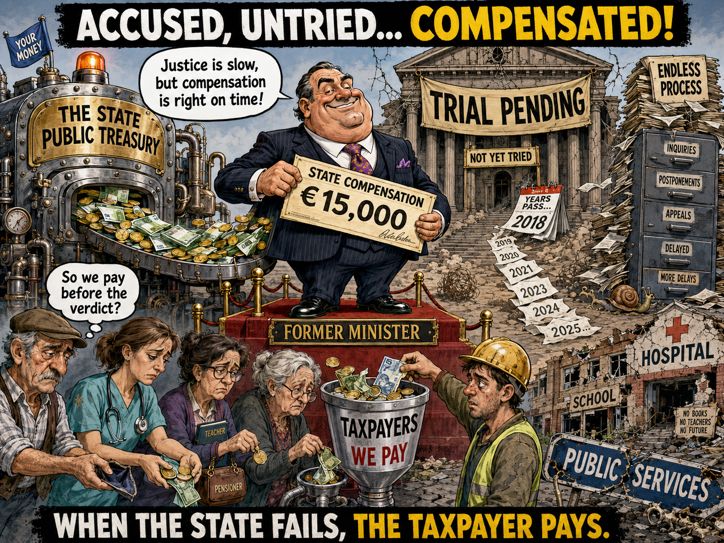
And then comes the symbolic blow: the State condemned to compensate José Sócrates for violations of judicial secrecy.
Once again, one must be serious: if the State violated rights, the court must recognise that violation. Judicial secrecy cannot be a sieve. The presumption of innocence is not decoration. A defendant, any defendant, has rights. And a rule-of-law State cannot fight suspicions of corruption by violating the very principles it claims to defend.
But the ordinary citizen looks at this and feels democratic nausea.
Because he understands that the State failed twice. It failed by taking years and years to produce a clear judicial answer. And it failed by allowing procedural violations that now result in compensation paid by those who did nothing: the taxpayers.
- The people did not violate judicial secrecy.
- The people did not conduct the investigation.
- The people did not write court orders.
- The people did not leak information.
- The people did not drag out the proceedings.
- The people did not benefit from suspicious deals.
- The people did not sit on boards of directors.
- The people did not make ruinous public policy decisions.
But they pay.
They always pay.
The Portuguese taxpayer is the financial cushion of national incompetence. Where the State falls, the taxpayer absorbs the blow. Where justice trips, the taxpayer pays. Where banking implodes, the taxpayer rescues. Where politics fails, the taxpayer bears the weight. Where the elite errs, the taxpayer learns austerity.
This is not a welfare state. It is fiscal servitude with a ballot paper.
6. The Theatre of Official Indignation
The most irritating thing is watching the political system pretend to be indignant whenever one of these disgraces comes to the surface.
- The parties issue statements.
- The commentators frown.
- Former officials say reflection is needed.
- Current officials promise reforms.
- The experts explain the complexity.
- Citizens are outraged for forty-eight hours.
- Then everything returns to normal.
And normal is the problem.
Because Portuguese normality has become obscene. It is normal for justice to take a decade. It is normal for judicial secrecy to appear on front pages. It is normal for the taxpayer to pay. It is normal for no one to be responsible. It is normal for the system to survive on the moral exhaustion of the people.
Portugal is not merely tired of corruption. It is tired of the normalisation of corruption, incompetence, and impunity.
The difference matters. A scandal still scandalises. Rotten normality anaesthetises.
7. It Is Not a Trial. It Is an X-Ray of the Regime
Operation Marquês has become a brutal X-ray of the Portuguese regime.
- It shows the fragility of justice.
- It shows the promiscuity between politics and business.
- It shows procedural delay as a democratic poison.
- It shows the system's contempt for citizens' time.
- It shows the inability of parties to reform the very structures from which they benefit.
- It shows the ease with which responsibility dissolves.
- It shows the arrogance of an elite that fails and still demands respect.
And it shows something deeper: Portugal has a State that collects like an adult, decides like a teenager, and takes responsibility like a child.
Portuguese democracy is not at risk because there are powerful defendants. On the contrary, a healthy democracy must be able to try the powerful. The problem is when the trial of the powerful takes so long that it becomes a ceremony of national exhaustion.
The problem is when justice ceases to be an instrument of truth and becomes a fog machine.
The problem is when citizens stop expecting justice and begin merely waiting for the next episode.
8. Political Guilt Does Not Need a Criminal Sentence
There is a convenient confusion that the system loves to promote: as if responsibility only existed when there is a criminal conviction.
No. There is political responsibility. There is institutional responsibility. There is moral responsibility. There is historical responsibility.
A system can be politically guilty even when justice has not yet convicted any concrete individual. It can be guilty for allowing promiscuity. For designing the wrong incentives. For choosing weak regulators. For tolerating conflicts of interest. For feeding major deals without sufficient scrutiny. For leaving justice without effective means. For legislating badly. For protecting careers. For pretending to reform.
Criminal justice condemns proven crimes.
History condemns systems that rot.
And Operation Marquês has already historically condemned a significant part of the Portuguese regime, even before the final judgment.
- It condemned it for delay.
- It condemned it for promiscuity.
- It condemned it for reformist cowardice.
- It condemned it for lack of shame.
- It condemned it for turning public trust into a disposable good.
9. The People Do Not Want Revenge. They Want Respect
Ordinary citizens do not want lynchings. That accusation is often used by those who want to silence legitimate revolt. When the people become indignant, someone always raises a finger and calls it "populism", as if demanding timely justice were a contagious disease.
The people want something much simpler:
- They want to know whether there was a crime or not.
- They want to know who received, who paid, who decided, who benefited.
- They want to know whether the millions that disappeared had authors.
- They want to know why major cases age in judicial oak barrels.
- They want to know why the State fails and the taxpayer pays.
- They want to know why the parties that governed this country continue to speak of responsibility as if they were moral tourists.
The people do not want revenge. They want respect.
And respecting the people means deciding. It means trying cases in due time. It means acquitting when there is no evidence. It means convicting when there is evidence. It means holding accountable those who violate procedures. It means reforming what is rotten. It means stopping treating citizens like fiscal idiots.
Conclusion: Sócrates Is the Name. The Regime Is the Trial
José Sócrates is the most visible name. But Operation Marquês is bigger than him.
It is the trial of a political generation. It is the trial of a culture of power. It is the trial of a justice system incapable of arriving on time. It is the trial of a party system that governs, fails, promises reforms, and continues. It is the trial of a democracy that demands trust without fully deserving it. It is the trial of a country where the powerful live in legal labyrinths and the small live in fiscal corridors.
The final question is not only whether José Sócrates will be convicted or acquitted. That decision belongs to the courts and must depend on evidence.
The greater question is whether Portugal will be able to politically condemn the system that made all this possible.
Because if, after failed banks, vanished billions, endless proceedings, leaks of judicial secrecy, compensation paid by taxpayers, and evaporated responsibilities, the country continues to vote, tolerate, and obey as if nothing had happened, then the harshest sentence will not be against a defendant.
It will be against us.
Not because of lynching. Not because of hatred. Not because of revenge.
But because of the abandonment of democratic demand.
A country that eternally accepts its own institutional humiliation stops being merely a victim. It becomes complicit through exhaustion.
And perhaps that is Portugal's greatest tragedy: not a lack of scandals, but a lack of consequences.
References and Sources Consulted
-
RTP Notícias — "After more than a decade, the Operation Marquês trial begins". RTP reported the start of the trial on July 3, 2025, referring to José Sócrates as being accused of 22 crimes and to the existence of 20 other defendants.
https://www.rtp.pt/noticias/pais/apos-mais-de-uma-decada-comeca-o-julgamento-da-operacao-marques_n1666502 -
RTP Notícias — "Operation Marquês. Twenty-one defendants accused of 117 crimes". Report on the universe of defendants and crimes charged by the Public Prosecutor's Office.
https://www.rtp.pt/noticias/pais/operacao-marques-vinte-e-um-arguidos-acusados-de-117-crimes_v1666436 -
RTP Notícias — "Operation Marquês. State ordered to pay 15 thousand euros to Sócrates for violations of judicial secrecy". Report on the partial condemnation of the State for non-material damages associated with violations of judicial secrecy.
https://www.rtp.pt/noticias/pais/operacao-marques-estado-condenado-a-pagar-15-mil-euros-a-socrates-por-violacoes-do-segredo-de-justica_n1750298 -
Reuters — "Portuguese former prime minister Socrates goes on trial in graft case". International context on the trial, the charges, and José Sócrates's position, as he denies wrongdoing.
https://www.reuters.com/business/finance/portuguese-former-prime-minister-socrates-goes-trial-graft-case-2025-07-03/ -
European Convention on Human Rights — Article 6, the right to a fair trial and to a hearing within a reasonable time.
https://www.echr.coe.int/documents/d/echr/convention_por -
Transparency International — Portugal's profile in the Corruption Perceptions Index. Portugal appears with a score of 56 and rank 46 out of 182 countries in the consulted profile.
https://www.transparency.org/en/countries/portugal -
European Commission — Communication on the 2023 Eurobarometers on corruption, indicating growing scepticism among European citizens regarding the phenomenon.
https://home-affairs.ec.europa.eu/news/commissions-2023-surveys-corruption-show-growing-scepticism-among-europeans-2023-07-05_en -
Reuters — "Portugal tightens anti-corruption rules to confiscate assets". Report on anti-corruption measures, public perception of corruption, and criticism of drawn-out judicial proceedings.
https://www.reuters.com/world/europe/portugal-tightens-anti-corruption-rules-confiscate-assets-2024-06-20/
Editorial Note
The Sócrates case is no longer merely a judicial case. It is a slow autopsy of the regime, performed in public, with the taxpayer paying for the morgue and still being lectured about trust in institutions.
The central point is precisely this: the rot is not only in the alleged crime. It is in the ecosystem that allows everything to drag on, dissolve, normalise itself, and then still present itself as a functioning rule of law.
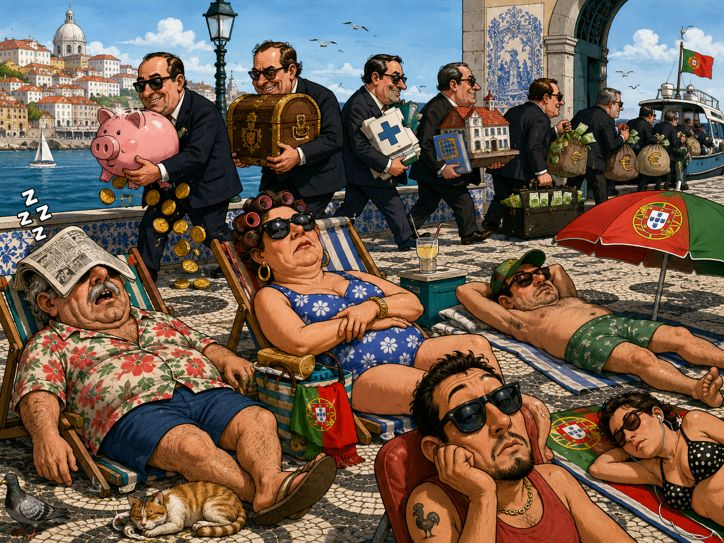
This is the Portuguese refinement: decadence always arrives well dressed, with a legal opinion, solemn language, and a sorrowful expression. Meanwhile, the ordinary citizen pays, waits, despairs, and is still invited to respect the institutional liturgy of impunity.
José Sócrates is the name. The regime is the trial. And the people, as always, are called upon to pay the sentence before knowing the truth.
Portugal does not suffer only from corruption. It suffers from an elite that has turned the absence of consequences into a model of governance.
This chronicle does not call for revenge. It calls for something far more dangerous to the system: responsibility. And in this country, that frightens more than any revolution.